
We Hit Full Solar Loop — in Winter. CSSGH Is Now a Tiny, Autonomous Micro-Farm.
- Gavriel Wayenberg
- Nov 22, 2025
- 3 min read

Updated: Nov 23, 2025
TL;DR: Our Closet-Size Smart GreenHouse (CSSGH) ran continuously for ~46 days through Belgian early-winter, then we shut it down by choice to avoid freeze damage — with the battery still at 78%. During that run it grew lettuce, cabbage, basil, and kept a 45 L aquatic biome (goldfish, shrimp, snails, Elodea & floaters) healthy, with an average service load of ~1 hour/month.

What we builtA closet-footprint aquaponics stack:
Ground: 45 L tank (goldfish + shrimp + snails + Elodea + floaters)
Mid: Papyrus phyto-filter (daytime solar recirculation)
Upper: Two tray levels for lettuce, cabbage, basil (expanded clay)
Energy: 200 W foldable PV + CTECHi GT200-3 (~320 Wh)
Control: Day = solar-only flow; Night = 2.4 W USB pump on intermittent schedule; one LED removed to minimize parasitic draw; smart top-up from a 24–48 h dechlorinated “arrosoir”
How we proved “full loop”
06 Oct → 21 Nov continuous operation (≈ 46.4 days).
Mid-run “OFF” was a crashed USB switch, not a flat battery; a quick reboot restored normal operation.
We winterized on 21 Nov 16:10 for freeze protection — the power station read 78% SoC.
In other words, solar IN ≥ system OUT even with short days and cold nights.
👉 Addendum report (ready for your dossiers): on demand
Why it matters
It’s tiny, affordable (~€750 PoC) and reproducible.
It produces edible greens while hosting a living aquatic biome — a genuine circular micro-farm.
It’s ultra-low maintenance: outside of harvests, we averaged ~1 hour/month (quick checks, filter/media swish, trimming).
It validates the investor thesis: a ~300–320 Wh pack + 200 W PV + smart intermittency is enough for winter-capable autonomy at this scale.
A note on maintenanceFrom our logs: once stabilized, routine interactions were limited to (a) weekly glance at SoC, (b) occasional hose/pump check, (c) plant trimming and outer-leaf harvests. Excluding harvest time, that’s ~15 min/week = ~1 h/month on average. (Spring setup & fall winterization are separate, one-off tasks.)
The castThanks to Coco,Stéphane , Emma , and Jérémy . Academic interest & context: Prof. Mari Sandell (University of Helsinki) and Janne Saariko (LUKE, Finland).
Recognition from a leading European urban-farming player
We’re honored that Olivia Frey (DACH Sales Manager, MyFood) reached out to congratulate Ajinomatrix BioSphere on the CSSGH winter full-loop milestone. MyFood’s decade of hands-on deployment across Europe gives real-world weight to this nod: their public impact figures highlight 1,300+ greenhouses installed, 360 tonnes of fruits & vegetables harvested in 2024, and 2,000+ citizens nourished—with an ROI note showing a 22 m² Family22 greenhouse can produce up to 400 kg/year, covering up to 80% of a small family’s needs, with a 4–6 year payback (source: MyFood site).
This external validation is especially meaningful because MyFood and AJXBSHDS are non-competing and complementary: they scale family/community food autonomy; we design nano-scale, sensor-driven, solar-autarkic micro-farms that fit in a closet. Together, these approaches sketch a continuum—from DIY micro-systems to neighborhood-level food resilience—with shared goals around low maintenance, clean energy, and data-backed reproducibility.
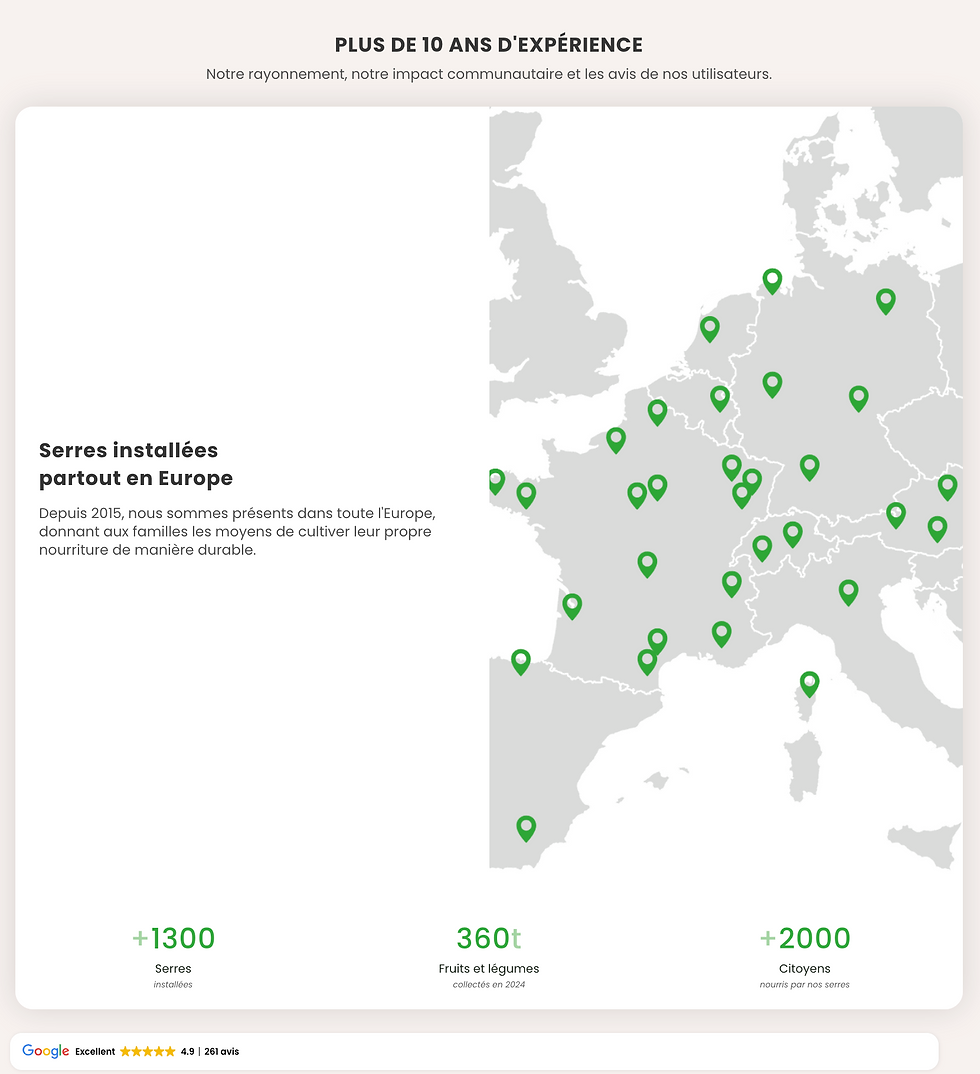
Source: MyFood.eu website - Installed base >1000 smart greenhouses and 10 years of experience.
What’s next
Publish a replication guide (+ materials passport)
Add a watchdog auto-reboot for the USB switch
Release an Eco+ / Eco-Pro parts list (recycled HDPE, silicone/TPE, LFP pack)
Run a school/lab cohort to compare yields (CSSGH vs soil control)
Want one? We can install a CSSGH PoC, train your team, or help you run a replication study.
Comments